Surprise, surprise! Vinyl records are making a comeback! Vinyl records played an important part in my life because, from 1972 to 1989, I was a disc jockey. Vinyl records were our main musical track storage devices: 7-inch 45 rpm singles, LPs—multi-track albums played at 33 rpm—and, latterly, from the mid-1980s, 12-inch 45 rpm singles. There were cassette tapes at the same time, but these tended not to be as popular as vinyl records. When I started with my own equipment in 1973, I had a two-channel valve amplifier delivering 25 watts per channel—an RMS power of 50 watts. The mixer was homemade, with basic tone controls and rotary volume faders. The lights were simple: normal coloured household lamps. In the space of just five years, not one piece of this original kit remained. The disco music industry was moving very fast.
Learning to Play for Everyone My journey on the path of experience started with a pub disco celebrating New Year’s Eve. Over the next five years, it took me through all types of events: weddings, birthday parties, work functions—including the Post Office Engineers’ Social Club—youth clubs, working men’s clubs, stag nights, hen nights, nightclubs, cricket and football club dances, doctors’ and nurses’ parties, and university dances. In fact, just about every type of function where music would be played. As a result of this diversity, my vinyl record collection reflected a range that far outstripped my original collection, which had largely consisted of music that I liked. Popular music in the early ’70s was quite varied. There was Tamla Motown, whose heyday was the middle to late ’60s, with popular stars such as the Four Tops, the Temptations, the Isley Brothers, the Supremes, Junior Walker & the All Stars, Marvin Gaye, Smokey Robinson, and Martha Reeves & the Vandellas. There was an extensive list of songs written by the brilliantly gifted songwriting trio Holland–Dozier–Holland.
In contrast, there was rock, with bands and artists such as Led Zeppelin, Pink Floyd, the Rolling Stones, Deep Purple, the Moody Blues, Genesis, Queen and David Bowie—to name but a few, I stress. Rock was not necessarily popular as dance music, but it still held regular top spots in the charts of the day. Funk was also growing in popularity, with the likes of James Brown, Kool & the Gang and the Commodores, and many new bands quickly adding to this evolving musical genre. Reggae, reflecting Jamaican musical influences, was also popular in the early ’70s: Bob Marley, the Upsetters, Harry J & the All Stars, Jimmy Cliff, the Melodians, Symarip and Derrick Morgan. Retro remained popular too, with regular plays of early Elvis, Roy Orbison, Bobby Vee, the Beatles, the Everly Brothers and other artists from the late ’50s and ’60s.
The Rise of the Disco Roadshow In the latter part of the ’70s, “disco” emerged into what would become a recognisable form of entertainment, one that contrasted with the live music of bands and artists. Many saw it as direct competition, as nightclubs and dance venues either introduced disco alongside their live performers or, in some cases, replaced live bands entirely for economic or practical reasons. Whilst there was a revolution in the development of disco equipment from the mid-’70s onwards, the basic track storage devices—the 7-inch 45 rpm singles, LPs and, latterly, 12-inch singles—remained unchanged. Technology, in less than five years, had jumped from valve amplifiers to power transistors. No longer were we constrained to Garrard SP25s with crystal cartridges driving 50-watt amplifiers. We were using high-end Technics turntables with Ortofon magnetic cartridges, with 500 watts per channel! The light shows went through similar developments. No longer were there just three coloured lights flashing. Our show was now using Boolean-algebra-driven sequencers and rainbow strobes. We used Tutor II studio-standard projectors with very sophisticated attachments that turned the walls of halls into psychedelic dreams!
Records had advanced too. We could now enjoy 12-inch mixes with very impressive sound quality. Record collections became vast—but also very heavy—along with the new generation of speakers, bass bins, piezoelectric horns, lighting banks, projector equipment and amplifiers. Roadshow DJs were becoming weightlifters! The roadshows were massive: two Ford Transit vans to transport everything, and a road crew to lift and set up.
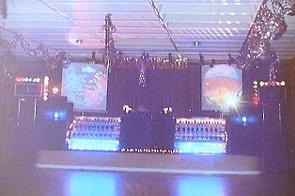
Photo caption: The stage in these pictures is 28 feet across!
A Partnership Ends In 1978, my partner Steve needed money for a house deposit and sold his share of the equipment to me. This would not have changed the equation but for another unfortunate event. His car boot was prised open, and his record collection was stolen. Sadly, that was the end of Steve’s disco days. There was nothing I could do. Sharing records was unworkable and impractical, and would give him little style of his own. Such a loss was tragic. We were musical connoisseurs, and such a loss was beyond words. It represented so many hundreds of hours searching record stores, picking up both oldies and limited-edition Northern Soul mixes.
I sympathised with Steve’s loss. I encouraged him to pick up the pieces, but financially that was impossible at the time. At the end of 1978, I was on my own again, and it was a tough time. The bookings kept coming in, but I became more conservative with what went out on a show, equipment-wise. It was at this time that the calling of resident work first emerged as a serious shift in my DJ career. Until this point, I had not considered working in resident locations. However, it began to look like easy money after six years of being on the road. Previously, we had taken a somewhat dismissive view of working resident venues. After all, we were power engineers, sound and light engineers, music masters and artists. And we were free—we had no bosses or promoters to answer to! But that thinking would give way to a more mature perspective. Despite all our skills, we were still considered amateurs in the industry, whereas resident DJs in Mecca nightclubs were thought of as being in a different league: professionals. It was really a baseless judgement of talent, but it was the way things worked.
A New Direction Mobile roadshows were the niche, underground, creative specialists that could turn any village hall into a fantastic venue. But everything has its time, and I was moving on. Working without Steve felt funny at first, but I again eased back into being a lone performer, as I had started out. The kit had grown, and instead of having help, I was carrying more. In the early days, it was just a couple of speakers and equipment that could all just about fit in a car. Now I was going out in a 28-cwt Transit van and routinely carrying the full kit in, all on my own. I think it was at this time that I reached my physical peak. However, it would become unthinkable to continue lifting that volume of equipment. A new chapter was waiting for me at the Café de Paris in London’s Leicester Square.
In Part 2, I recall the happy years at the Café de Paris, one of London’s premier and famous ballrooms. The music and memories of that magnificent ballroom, and the journey that eventually took me to my final roadshow in Hong Kong. And I return to the question that started it all: why is vinyl making a comeback?
Surprise, surprise! Vinyl records are making a comeback! Vinyl records played an important part in my life because, from 1972 to 1989, I was a disc jockey. Vinyl records were our main musical track storage devices: 7-inch 45 rpm singles, LPs—multi-track albums played at 33 rpm—and, latterly, from the mid-1980s, 12-inch 45 rpm singles. There were cassette tapes at the same time, but these tended not to be as popular as vinyl records. When I started with my own equipment in 1973, I had a two-channel valve amplifier delivering 25 watts per channel—an RMS power of 50 watts. The mixer was homemade, with basic tone controls and rotary volume faders. The lights were simple: normal coloured household lamps. In the space of just five years, not one piece of this original kit remained. The disco music industry was moving very fast.
Learning to Play for Everyone My journey on the path of experience started with a pub disco celebrating New Year’s Eve. Over the next five years, it took me through all types of events: weddings, birthday parties, work functions—including the Post Office Engineers’ Social Club—youth clubs, working men’s clubs, stag nights, hen nights, nightclubs, cricket and football club dances, doctors’ and nurses’ parties, and university dances. In fact, just about every type of function where music would be played. As a result of this diversity, my vinyl record collection reflected a range that far outstripped my original collection, which had largely consisted of music that I liked. Popular music in the early ’70s was quite varied. There was Tamla Motown, whose heyday was the middle to late ’60s, with popular stars such as the Four Tops, the Temptations, the Isley Brothers, the Supremes, Junior Walker & the All Stars, Marvin Gaye, Smokey Robinson, and Martha Reeves & the Vandellas. There was an extensive list of songs written by the brilliantly gifted songwriting trio Holland–Dozier–Holland.
In contrast, there was rock, with bands and artists such as Led Zeppelin, Pink Floyd, the Rolling Stones, Deep Purple, the Moody Blues, Genesis, Queen and David Bowie—to name but a few, I stress. Rock was not necessarily popular as dance music, but it still held regular top spots in the charts of the day. Funk was also growing in popularity, with the likes of James Brown, Kool & the Gang and the Commodores, and many new bands quickly adding to this evolving musical genre. Reggae, reflecting Jamaican musical influences, was also popular in the early ’70s: Bob Marley, the Upsetters, Harry J & the All Stars, Jimmy Cliff, the Melodians, Symarip and Derrick Morgan. Retro remained popular too, with regular plays of early Elvis, Roy Orbison, Bobby Vee, the Beatles, the Everly Brothers and other artists from the late ’50s and ’60s.
The Rise of the Disco Roadshow In the latter part of the ’70s, “disco” emerged into what would become a recognisable form of entertainment, one that contrasted with the live music of bands and artists. Many saw it as direct competition, as nightclubs and dance venues either introduced disco alongside their live performers or, in some cases, replaced live bands entirely for economic or practical reasons. Whilst there was a revolution in the development of disco equipment from the mid-’70s onwards, the basic track storage devices—the 7-inch 45 rpm singles, LPs and, latterly, 12-inch singles—remained unchanged. Technology, in less than five years, had jumped from valve amplifiers to power transistors. No longer were we constrained to Garrard SP25s with crystal cartridges driving 50-watt amplifiers. We were using high-end Technics turntables with Ortofon magnetic cartridges, with 500 watts per channel! The light shows went through similar developments. No longer were there just three coloured lights flashing. Our show was now using Boolean-algebra-driven sequencers and rainbow strobes. We used Tutor II studio-standard projectors with very sophisticated attachments that turned the walls of halls into psychedelic dreams!
Records had advanced too. We could now enjoy 12-inch mixes with very impressive sound quality. Record collections became vast—but also very heavy—along with the new generation of speakers, bass bins, piezoelectric horns, lighting banks, projector equipment and amplifiers. Roadshow DJs were becoming weightlifters! The roadshows were massive: two Ford Transit vans to transport everything, and a road crew to lift and set up.
Advertisement
Photo caption: The stage in these pictures is 28 feet across!
A Partnership Ends In 1978, my partner Steve needed money for a house deposit and sold his share of the equipment to me. This would not have changed the equation but for another unfortunate event. His car boot was prised open, and his record collection was stolen. Sadly, that was the end of Steve’s disco days. There was nothing I could do. Sharing records was unworkable and impractical, and would give him little style of his own. Such a loss was tragic. We were musical connoisseurs, and such a loss was beyond words. It represented so many hundreds of hours searching record stores, picking up both oldies and limited-edition Northern Soul mixes.
I sympathised with Steve’s loss. I encouraged him to pick up the pieces, but financially that was impossible at the time. At the end of 1978, I was on my own again, and it was a tough time. The bookings kept coming in, but I became more conservative with what went out on a show, equipment-wise. It was at this time that the calling of resident work first emerged as a serious shift in my DJ career. Until this point, I had not considered working in resident locations. However, it began to look like easy money after six years of being on the road. Previously, we had taken a somewhat dismissive view of working resident venues. After all, we were power engineers, sound and light engineers, music masters and artists. And we were free—we had no bosses or promoters to answer to! But that thinking would give way to a more mature perspective. Despite all our skills, we were still considered amateurs in the industry, whereas resident DJs in Mecca nightclubs were thought of as being in a different league: professionals. It was really a baseless judgement of talent, but it was the way things worked.
A New Direction Mobile roadshows were the niche, underground, creative specialists that could turn any village hall into a fantastic venue. But everything has its time, and I was moving on. Working without Steve felt funny at first, but I again eased back into being a lone performer, as I had started out. The kit had grown, and instead of having help, I was carrying more. In the early days, it was just a couple of speakers and equipment that could all just about fit in a car. Now I was going out in a 28-cwt Transit van and routinely carrying the full kit in, all on my own. I think it was at this time that I reached my physical peak. However, it would become unthinkable to continue lifting that volume of equipment. A new chapter was waiting for me at the Café de Paris in London’s Leicester Square.
In Part 2, I recall the happy years at the Café de Paris, one of London’s premier and famous ballrooms. The music and memories of that magnificent ballroom, and the journey that eventually took me to my final roadshow in Hong Kong. And I return to the question that started it all: why is vinyl making a comeback?