Vinyl records played an important part in my life as a disc jockey from 1972 to 1989. In Part 1 of “Let’s Talk Vinyl”, I recalled my beginnings on the mobile disco circuit, the extraordinary growth of our sound and lighting equipment, and the record collection that grew as I learnt to play for every kind of audience.
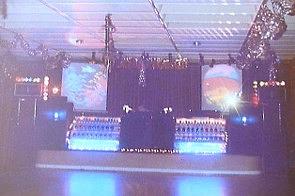
By the end of the ’70s, after years of carrying equipment into halls and venues, I was ready for a new direction. That brought me to the Café de Paris in London’s Leicester Square.
By the end of the ’70s, after years of carrying equipment into halls and venues, I was ready for a new direction. That brought me to the Café de Paris in London’s Leicester Square.
The Café de Paris
When I first played the Café in the autumn of 1979, disco had been introduced only a few months earlier and had been hosted by a DJ called Tony Charles.
Apparently, it had worked after a fashion, but it was not quite the equation that management wanted. Tony was focused on teenage audiences and did not want to get fixed into the Café’s broad musical spectrum: nostalgia, strict tempo and pop.
I believe my first night there was a success, based on my well-practised knowledge of catering for everyone, gleaned from roadshows, parties and weddings.
At the end of the evening, I told the manageress how much I had enjoyed working there and that I would jump at the opportunity to work there again.
It would be another three months before the call came, and I would finally become a contract Mecca DJ. So, in the early part of 1980, I started regular work at the Café.

The Kinks’ “Don’t Forget to Dance” was filmed at the Café de Paris in 1983.
The early days at the Café were happy days. There are many wonderful memories from the 1980–83 period.
The Café always had something going on. The music was also great. I loved working with live musicians, and our shows complemented one another.
The audience was a complete cross-section of ages, but one thing was for sure: everybody came to the Café to dance and have a great time.
Discovering a Lost Musical Treasure
From working at the Café, I also learnt about the great British dance-band music of the ’20s, ’30s and ’40s.
I worked on the David Carter “Up West” radio show, which was nostalgia-focused. I met Ivor Moreton, Denny Dennis and Ivor Rabin, all of whom were stars from the great dance-band era.
Ivor Rabin was a senior manager in Mecca. His father was Oscar Rabin, the famous bandleader from the Hammersmith Palais.
I developed a great love of Al Bowlly’s music. He had been a regular performer at the Café. I felt his songs and the music of the early and late ’30s were a lost renaissance.
I could not understand why he was not being played on radio, and why it seemed that no one else knew of him. He was killed in the Blitz in 1941.
From working at the Café, I also learnt about the great British dance-band music of the ’20s, ’30s and ’40s.
I worked on the David Carter “Up West” radio show, which was nostalgia-focused. I met Ivor Moreton, Denny Dennis and Ivor Rabin, all of whom were stars from the great dance-band era.
Ivor Rabin was a senior manager in Mecca. His father was Oscar Rabin, the famous bandleader from the Hammersmith Palais.
I developed a great love of Al Bowlly’s music. He had been a regular performer at the Café. I felt his songs and the music of the early and late ’30s were a lost renaissance.

There were times when I would have the whole Café to myself. I would have from 6.00 pm to 7.30 pm to play the music of the ’30s. Only some of the staff were present, but nevertheless, I would dim the lights and travel back in time.
The engaging sound of the Roy Fox band again echoed through the Café, as did other notable greats in the growing vocabulary of my collection: Jack Buchanan, Elsie Carlisle, Denny Dennis, Lew Stone, Oscar Rabin, Al Bowlly and many more.
Some of the team would sit quietly at the tables and listen to this lost treasure, re-found.
I felt something I cannot put into words, other than to say there was a special communion between this magnificent hall and myself. I knew what musical moments and emotions these walls had witnessed.
I was a young priest of the music—I sought it and loved it.
I could feel all of those times embrace me: a silent message that longed to hear those special melodies again.
In return, I was given something special to charge me. The Café de Paris held me as one of its sons.
Three Musical Personalities
By the mid-’80s, my sets at the Café had three distinct personalities.
In the early evening, at 7.30 pm, my first set was a mix of strict tempo and danceable music. After that, the jazz band would perform a 90-minute show.
My middle set was international music, very danceable but mainly pop: music from Germany, France and Greece, popular UK music, and Arabic music.
My final set, from midnight to 2.45 am, was heavy funk, house and acid jazz. It was a full-on session of real club music for two and three-quarter hours!
Then followed 15 minutes of slow songs, closing at 3.00 am.

It is hard to explain the diversity of the music during the ’80s. I would need to write a much more comprehensive article to cover the full scope of what was going on in that decade.
I can best describe it as a “renaissance period” that, to my mind, has not been repeated in terms of diversity and creative excellence. The artists, the bands, the songs and the sheer amazing musical creations await to be equalled.
Why would you not want to collect these wonderful records?
Incredible vinyl memories!

But What Came Next?
In October 1989, I left the Café de Paris for New York and a career with Cable & Wireless—nothing to do with music.
I went there believing I would find DJ work, but it was not to be.
The clubs there were so divided in their musical tastes that it was quite unbelievable. It was deeply saddening to me—a DJ from a top London nightclub—to find people so blinkered in their musical choices.
This was in contrast to what I was used to: playing all musical genres, and even international music, within my show sets.
After a two-year stint in New York, I was sent to Sydney, Australia, to work for Optus Communications.
Meanwhile, my vinyl records and my repertoire of music remained with me. It would be almost 13 years before I stepped onto a stage again to entertain: to place my Ortofons into my Technics decks, fire up my CD players, and stand before an audience once again.
As a music lover, I had kept up with music through the purchase of CDs, but I had not abandoned my vast vinyl collection of musical treasures.
OK—So Now There Were CDs
Around the early 1990s, CDs emerged into my musical life.
Oh wow! Tiny, shiny discs, as opposed to 12-inch singles, boxes of 7-inch 45s or LPs.
The musical storage device was changing! But you needed a new player—no longer a turntable.
I was not working in any capacity as a DJ, but I welcomed the idea of my collection’s content becoming a practical fraction of its size.
I duly embraced this and purchased many duplicates of what I already held on 7-inch and 12-inch records or albums.
My Final Roadshow
After years abroad, I returned to Hong Kong in the early 2000s.
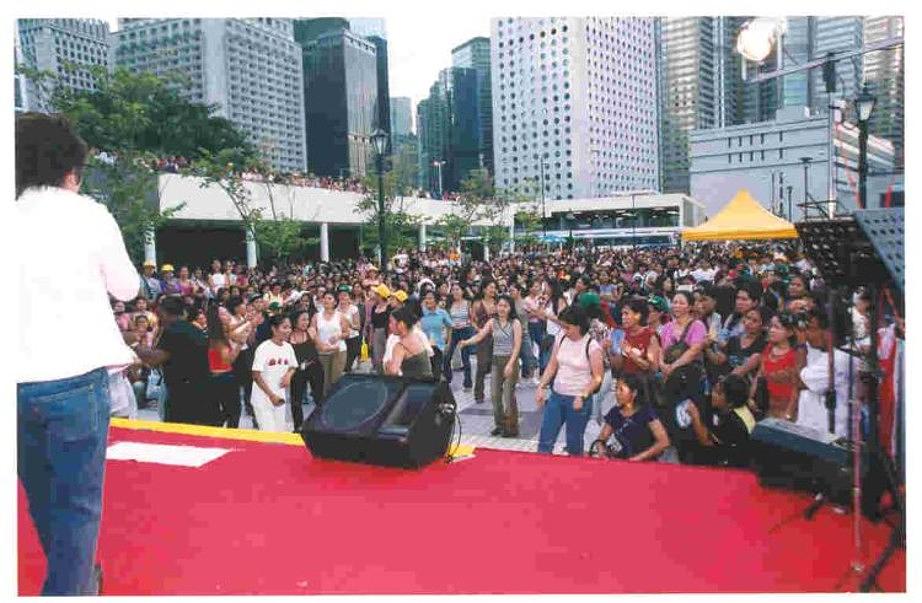
My final show as a performing DJ was in Admiralty in 2004. It was an enormous event, and I was proud to be the honoured DJ.
After years abroad, I returned to Hong Kong in the early 2000s.
My final show as a performing DJ was in Admiralty in 2004. It was an enormous event, and I was proud to be the honoured DJ.

At least 2,500 people were there on the night, and I was very happy to have made people feel so good.
It was the perfect end to an amazing career in music.
In hindsight, it was my swan song!
It was the perfect end to an amazing career in music.
In hindsight, it was my swan song!

Photo caption: My last roadshow, Hong Kong, 2004. A massive audience turned up—at least 2,500 people enjoying the music in Admiralty.
Sometimes happiness just pours from being with friends and enjoying the magic of music.
“The task for me was to make people jump and make them feel happy!”
Sometimes happiness just pours from being with friends and enjoying the magic of music.
“The task for me was to make people jump and make them feel happy!”
So Why Is Vinyl Making a Comeback?
For me, the answer is very simple: because it is an entirely tactile experience.
We can touch and hold something physical that connects us to a memory or happy times we can relate to.
You can hold it! You can feel it.
You don’t need to access a cloud or log into somewhere. It is the pleasure of holding something in our hands because it is tangible and holds very precious memories.
We can feel and hold all that is special.
This is the difference!
It is only my personal opinion, but I think the sound quality of vinyl is better than that of CDs.
Now, in the 2020s, it seems things have come around full circle. But why?
Music has migrated from vinyl to CD, then to online services such as YouTube and Spotify, and now it is returning to vinyl. Why is this so?
As I have mentioned, its enduring popularity is, for me, about remembering music in a tactile sense: touching things to trigger memory, having something tangible to hold—sometimes in reverence of special times—which brings back memories of times gone by.
Otherwise, memory fades, and songs, if not moments, are forgotten.
For me, these records are much more than a collection. They are incredible vinyl memories.